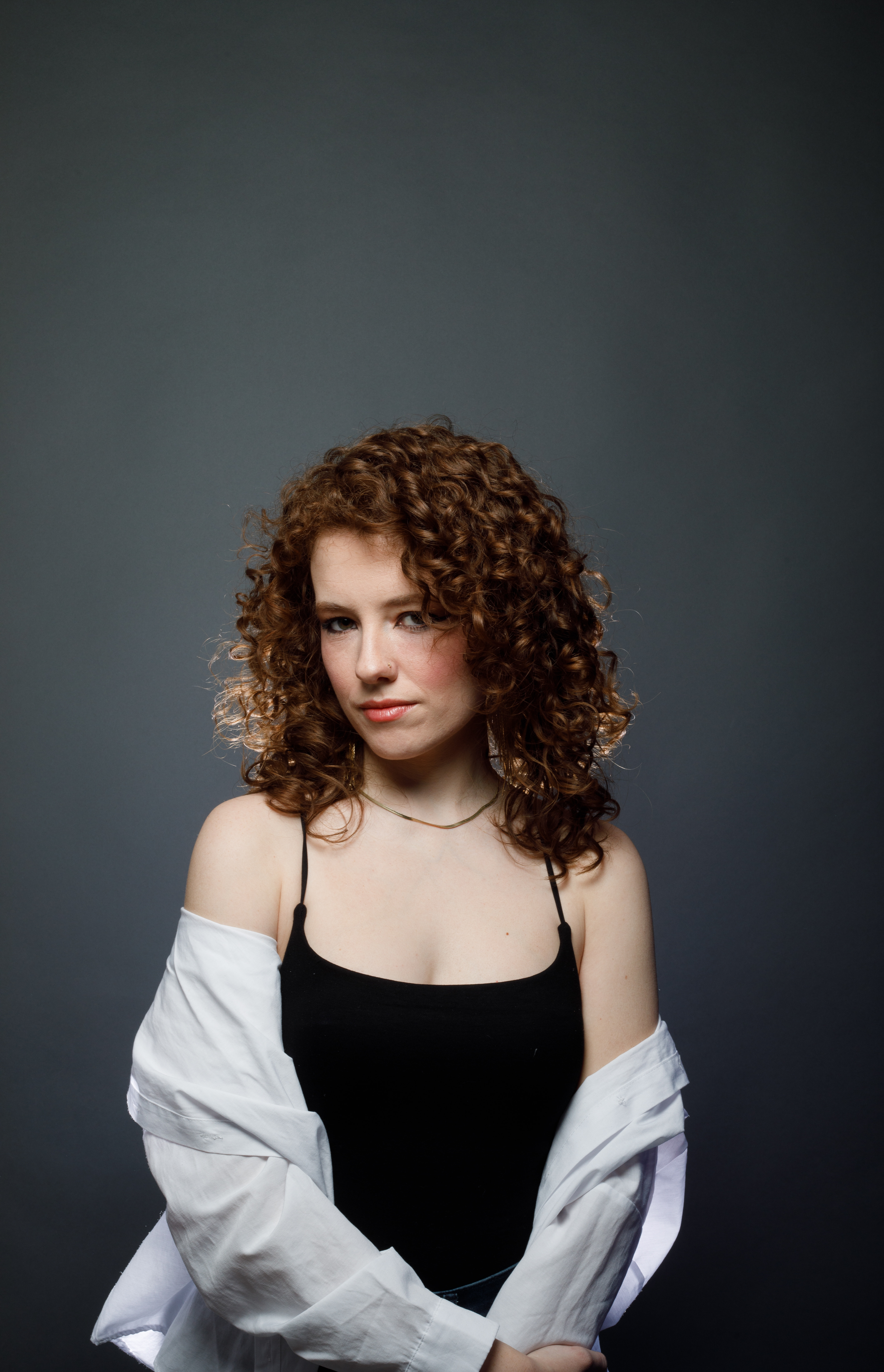
Celebrated Montréal-based jazz pianist and composer Kate Wyatt returns with her electrifying new album Murmurations, a shimmering testament to group empathy and musical dialogue. Joined by Montréal jazz heavyweights Adrian Vedady on bass and Louis-Vincent Hamel on drums, the Kate Wyatt Trio delivers a collection of original compositions by each member, weaving together sensitivity, spontaneity, and a nearly telepathic interplay.
The concept of Murmurations – inspired by nature’s spectacle of birds moving in unison – perfectly captures the essence of this album. Just as flocks of starlings shift and turn as one, the trio moves and breathes as a single organism: responsive, trusting, and deeply attuned to the moment.
Renowned for her creative imagination and finesse, Paul de Hueck and Norman Walford Career Achievement Award nominee Kate Wyatt has earned a reputation as one of Canada’s most compelling jazz voices. Her debut album Artifact received glowing reviews and was featured on a number of Best Jazz of 2022 lists internationally. On Murmurations, Wyatt’s dynamic compositions are joined by those of Vedady and Hamel, each bringing unique textures and perspectives to the trio’s collective sound. The album also features a fresh, surprising take on the Kurt Weill standard Mack the Knife, highlighting the group’s playful side and inventive spirit.
Murmurations will be released on October 10, 2025 on all major streaming platforms and in physical formats. The trio will be touring across Canada in support of the album, bringing their uniquely interactive and sensitive sound to audiences nationwide.
VOCALIST-COMPOSER SARAH ELIZABETH CHARLES TO RELEASE DAWN ON OCTOBER 3, 2025 via STRETCH MUSIC x ROPEADOPE. A NEW ENSEMBLE AND INTIMATE EXPLORATION OF LIFE, LOSS & MOTHERHOOD MARK HER LATEST WORK.
“Ms. Charles has a soulfully articulate vocal style, a mix of strong projection, and subtle detail . . . she connects deeply with her band.” Nate Chinen (New York Times)
“. . . Genre of one . . . Charles is fully in control, and figures to be for a very long time.” Joe Tangari (DownBeat)
“Impeccable technical prowess providing the base for boldly uninhibited expression, all driving sharply shaped political and cultural views: It’s a combination as rare as it is thrilling, bringing to mind Betty Carter and Abbey Lincoln, and, over the past half-decade, the neo-soul-meets-jazz fervor of Sarah Elizabeth Charles.” Christopher Loudon (JazzTimes)
“I’ve been an open book through my music for years and . . . I don’t really see any reason to stop that now. It’s what I’m choosing to share.”
Brooklyn-based vocalist, composer, and educator Sarah Elizabeth Charles has been steadily rising as a singular voice in contemporary jazz since her 2012 album debut. From that time to now, her approach to the genre — both sonically and as a source of scholarship, community building, and social consciousness — has rendered Charles a dynamic force as a performer, collaborator, and changemaker.
In addition to leading her ensemble, SCOPE, for over a decade (a notable achievement in an ever-changing industry), she has also emerged as a powerful advocate for gender justice, incarcerated individuals, and early childhood music education, developing original courses and co-leading programs that center each through organizations and institutions including The New School, Rise2Shine, and Carnegie Hall. Her musicianship, identified by her powerful songwriting, evocative and rich lyrics, and exceptional vocal execution, has been inextricably linked to meaningful themes that hold personal significance. With her fifth album, Dawn, Charles is at her most vulnerable yet — and also her most empowered.
Dawn, is both an expansive and intimate reflection on birthing, loss, joy, grief, hope, and transformation. Written over the course of four years and recorded in 2024 while six months pregnant with her second child, Charles crafted the album in real time, processing the miscarriages she experienced before carrying each of her sons to term, mourning the loss of loved ones, and celebrating the births of her two sons. Across ten exquisite tracks, Dawn reveals the complexities of these experiences with stunning transparency and beauty.
Charles debuts an exciting new ensemble including pianist Maya Keren, bassist Linda May Han Oh, drummer Savannah Harris, violinist Skye Steele, and cellist Marika Hughes — with her husband, pianist and composer Jarrett Cherner, contributing string arrangements. “I’ve released four albums with my longtime band and I’m so grateful for their commitment to my music over the years. In this moment though, I felt ready to work and collaborate with new people. I wanted to challenge myself to do this while moving through a new life experience.”
Beginning with the title, Dawn explores the themes of loss and renewal that have helped shape Charles’s personal and creative journey. Just a month after experiencing her first miscarriage, she lost her older brother, Luke, in 2020. In the years that followed, she also celebrated the births of her two sons. “Luke is derived from the name Lucius, which means ‘the bringer of light,’ or ‘the one born at dawn,’” she explains. “Our first son Tyler’s middle name, Dawn, is in honor of my brother and felt right as the title of this album, symbolizing the light that both of our children have brought into our lives.”
An aural synthesis of raw beauty and honesty, Dawn invites listeners to move through these difficult yet universal themes. The album’s depth leaves no room to hide — from neither the artist nor oneself as the listener. With poignant, suite-like textures and exquisite musicianship, Charles navigates these truths as producer, lyricist, songwriter, and vocalist, with a full spectrum of clarity, courage, and emotional resonance.
In that spirit, Dawn brilliantly unfolds, opening with “Rainbow J,” (the first of two celestial interludes), that instantly immerses the listener. Charles’s inspirations for this work are at the heart of this song cycle from the outset: the heartbeat of her son Jaden and the voice of her son Tyler are woven into a tapestry of improvisation and original lullaby. These precious elements, sampled and looped; the distant reverberation of Charles’s layered vocals; and Harris’s soft mallets rising gently beneath, all establishing a spacious, ethereal soundscape.
“Ground” is a gorgeous two-minute bowed bass solo from Oh that brings us gently back to earth, yet it remains suspended in something mystical. It draws on classical traditions without fully belonging to them, as Oh singularly builds a harmonically rich, texturally layered, and emotionally resonant passage. Her bass seems to weep — not out of sorrow, but with a transcendent hope.
Oh’s solo closes by quoting the poignant melody of what becomes “Discovery.” In a seamless transition, subtle layers of instrumentation — including an almost cinematic arrival of a full string section — gradually emerge, expanding the musical vista. By the time Charles delivers the opening line, there is an irresistible submission to the journey the album is embarking on. Harris and Keren enter, and the complete ensemble builds powerfully, ultimately culminating in a breathtaking, multi-layered vamp. On its meaning, Charles says, “It’s both about fearing and welcoming. About how my life was changing — and would change — with the birth of our first son. I knew that I couldn’t control the shifts that were happening in me or who he was going to be. So that ending section, ‘I can’t hold you / time to be true / time to be who you are’ That’s both me speaking to myself and speaking to him.”
“Miracle” blossoms within a fixed sonic, tonal, and harmonic space, compositionally meditative, allowing its atmosphere to “just be,” as Charles describes it. Composed during her pregnancy with her son, Tyler, it embodies the wonder and curiosity that accompanies the anticipation of new life.
Up to this point in the album, Cherner’s affecting string arrangements largely establish both mood and tone. “I’ve loved my partner’s writing and arranging, specifically for strings, for a very long time,” says Charles. “I feel like there’s this clarity in his arrangements that epitomize who he is individually. His quiet, steady support and the grounding that he offers for our family feels musically present here.
“Kick” celebrates the first sensation of Tyler’s in utero movements. Anchored by Harris’s steady mid-tempo groove and Charles’s repeating vocal phrasing, the rhythm section locks into a delicious synchronicity, as Charles’s vocalizations effortlessly shift between ethereal echoes, bellowing scats, and everything in-between. Keren’s addition of Rhodes adds the perfect texture as the band splendidly opens up over the changes. “Kick” joyfully yet reverently channels the otherworldly experience, at once deeply physical and spiritually ancestral, as Charles sings, “Generations move through me.”
“Plans” reckons with the unpredictability of birthing. Written after a STAT C-section, it honors an experience that unfolded far differently than Charles had hoped for — including being unconscious for her son’s first moments and not meeting him until hours after his birth. “At one point, I thought that I had finished the music for this song cycle, but the more I reflected, the more I realized that it felt like there was an experiential piece missing. I hadn’t musically processed my grief for what I hoped the birth would be. “Plans” is my musical exploration of this moment in time.” Beyond the personal, “Plans” also echoes the broader realities of maternal health inequities, as Black and POC women/birthing people in the U.S. face disproportionately high rates of complications and preterm births. With “Plans,” Charles surrenders to what is, offering gratitude for the care she and her baby received.
“Rainbow T,” the counterpart interlude of “Rainbow J,” is embedded in the same in utero heartbeat, toddler vocalization, and improvisation. The interludes each build upon a singular 20-minute improvisation, creating a lo-fi, dreamlike space that draws the listener back to Charles’s most intimate intentions and the emotional center that roots the album.
In contrast to the album’s more intimate tone, “Mother” is described compositionally as “Classic Sarah,” and boldly demands visibility and recognition for birthing people. “I feel like ‘Mother’ is an assertion,” she says. “We don’t actually ‘recognize the sacrifice, we don’t see the contribution, we don’t understand the body, mind, and spirit execution’,” she adds, quoting the powerful lyrics of the chorus. “The actual energy that it takes to move through the experiences of pregnancy, birthing, and mothering. People do not, in my experience, take the time to fathom what that actually is because it’s so common and taken for granted. This song is a call to honor the complexity of the work that often goes unseen and undervalued.” Sparkling solos from Keren, Oh, and Harris underscore Charles’s commanding performance on this anthemic, celebratory piece.
“Angel Spark” addresses miscarriage, a subject rarely explored in music. Originally recorded on her previous album with SCOPE, Charles revisits the piece on Dawn, with her new ensemble and an expanded arrangement that includes gorgeous string arrangements, written by Cherner and beautifully played by Steele and Hughes. Charles softly repeats echoes of “go,” in an intimate moment representing the release of the two beings she miscarried, who she deeply felt to be her daughters. “Who knows who they were or would have been?” she reflects, “but that’s not really what matters — only what feels true and what I felt moved to express.” Charles’s lyrics give language to the grief singular of this maternal experience. Can you love a thing that never was? / Can you mourn anticipation lost? / Can you hold that love so close and let it go? / Oh, let it go.
If “Angel Spark” gives language to the grief, “Questions” steps deeper into the emotional terrain, musing on both the imaginings that often follow loss, and the wonder of the new life before her eyes. A duet between Charles and Oh, the lyrics pose tender queries on the unknowns of life — where we come from, who we become, and the spirits we may have encountered before coming earthside. There’s a hope in the message: that love continues to resonate beyond ourselves and endures in both presence and absence.
With Dawn, Charles triumphantly exhibits the metamorphic power of music. And she maintains what has always been at the heart of her artistry — music as witness, as an offering for transformation, and as testament. “I hesitate to share who I fully am less than I used to,” Charles reflects. “For me, this has been a direct result of motherhood. The experience of having my two sons has given me the permission, the courage, and the power to be my full self, unapologetically.”
The new album from Singer, songwriter and producer China Moses
Released October 3rd.
Purchase here
Singer, songwriter and producer China Moses evolves her artistry in truth. Defiantly real, her music resists what so many labels and critics desire: category. She captivates listeners with her deep pocket, sensitivity and wit, drawing inspiration from endless styles in the expansive lineage of Black American music.
Frank and fearless, China’s songs document fleeting emotional states and extended narratives, often leaning into self-reflection both in lyric and phrasing. Her voice is a satin ribbon wrapped around a crackling flame. Listeners fortunate to observe her in live performance know the depth of her song interpretation. In a moment she can revolve a world.
I don't know where to begin except to say thank you—really, truly thank you.
Thank you for being curious enough to step inside this intense moment of creation that stretched between London and NYC, across time zones and heartbeats and the kind of musical magic that doesn't announce itself until it's already happening.
Terri Lyne Carrington - yes the one and only - listened to my previous album "Nightintales" and told me something I didn't understand at first: "You need to go home." Oli Rockberger lent me his incredible talent to shape and finalise the songs and later, Troy Miller, the producer of this album, said the same thing:
"You need to go home. You need to record in NYC."
I didn't get it, but I trusted. I've always trusted—sometimes blindly—trying to honor the wisdom and experience of the people who speak to me.
I was guided. I am not alone.
Troy and I spent hours talking about the sound we were chasing. He was insistent about one thing: he wanted to capture the essence of who I am on stage. "That deep voice," he said, "raspy, sometimes imprecise but always, always right." No one had ever described my voice that way—like imperfection was its own kind of perfection.
I was guided... I am not alone.
My musical sister, Lakecia Benjamin, was the first person I called. We had history—I'd sung on her album "Rise Up"—and she understood what this meant. Then Theo Croker, who's family in every way that matters. I reached out to Daru Jones because we'd had this project years back that never quite materialized, but damn if that man doesn't have a sound that hits different. Troy, who knows his way around a kit himself, heard the first measure of the demo for "My Part Of Town" and immediately asked: "Who's the drummer? Sounds like your rhythmic counterpart."
He was right. Daru and I have known for years that our sounds work beautifully together.
Mike King came through Theo—he was in his band and later became my mother's pianist when she was producing Theo. Theo brought trombonist Corey Wilcox, son of the great Wycliffe Gordon. Troy thought of his friend Michael Olatuja from their early days with Soweto Kinch. And Michael brought Marvin Sewell and Marvin brought 8 guitars...
I was guided. I am not alone.
But would everyone be free the same three days the studio was available? The same studio where Daru and I had recorded that earlier project that didn't materialize? The answer was magical: Yes.
I called photographer Adrianno Vannini, who captures the life of traveling musicians and has this gift for freezing musical moments—you can hear the sound in his images.
Three days to record everything. No time for restaurants, no time for anything but the work. But more than that, I needed to create family—everyone eating the same food, sharing the same nourishment, the same space, the same intention. Francisco Ciniglio, drummer and chef, cooked us dishes made of love, sustenance for the soul-work we were about to do.
I am not alone. Every decision, every encounter from my past led me here, to this moment, to this music.
This album you're holding, this music you've chosen to invite into your life—it carries all of this with it. The intensity of effort, the depth of love, the sacred intention woven between every note, every word you're about to receive.
Let me tell you about the decisions that brought me to you, brought this piece of audio art to your ears...
Korean composer/conductor Rin Seo releases City Suite, a decade-long reflection on her time in New York as a female immigrant composer, releasing October 3, 2025 via Cellar Music Group
For many across America, New York City stands as a monument to the history, tradition, and spirit of America from its foundation. For New York-based Korean composer and conductor Rin Seo, New York City stands as a monument to personal trial, ambition, struggle, and triumph. Now, with ten years of reflection, craftsmanship, and artistic development, Seo presents City Suite, an opening statement that powerfully showcases her ability to blend influences of Western classical, jazz, theater, and Korean folk music to spin stories and tell tales that enrapture audiences. As legendary composer Jim McNeely says, “[Seo's] imagination and skill have produced a marvellous album” that features a “big-enough band…to provide power when needed but can also be very lyrical and flexible when changing textures.” Featuring a 14-piece ensemble with guest appearances by trumpeter Ingrid Jensen, the Rin Seo Collective poignantly brings to life every twist and turn of the tapestry that Seo has woven.
The album’s title, City Suite, is derived from the name of the opening three-movement suite on the album. This tripartite work collectively reflects Seo's impressions of New York - the city in which she chose to pursue her dreams and lived for 7 years. The suite opens with “The Big Apple,” an upbeat, dynamic piece that portrays this city's characteristic fast pace and ambition. Next is “Cityscape,” a funky piece with a riveting groove which captures two parallel emotions: the first being the awe and dazzling beauty of New York's skyline by night, while the second being the sense of isolation and nostalgia spurred on by the urban life that such a skyline represents. The final movement in the title suite is “Alone, but Not Alone,” whose inspiration came to Seo while on a solitary walk. The piece embodies the sense of loneliness that accompanies chasing a dream in a city of such magnitude and pairs it with the hopeful realization that when surrounded by friends, family, and colleagues, one is never truly alone.
The storytelling nature of the title pieces makes City Suite an apt name for the album, as the remaining five pieces likewise evoke tales of New York that further expound upon the ideas presented in the suite. With four additional original compositions and a greatly reconstructed arrangement of Wayne Shorter's “Blues à la Carte,” Seo captures emotions, events, people, and places that have been a part of her life during her decade in the United States.
The album's emotional journey continues with "Music for Dance No. 2," where Seo draws inspiration from the fluid movements and free expression of modern dance. Infused with vibrant Afro-Cuban rhythms, this piece serves as a musical tribute to New York City itself—celebrating the city’s vast cultural diversity, energy, and love that has shaped Seo's artistic vision. The album finds its poignant conclusion with "Riding a Bike," a fitting metaphor for life's inevitable ups and downs, falls and recoveries, and the resilience required to keep moving forward. Featuring the masterful artistry of trumpetist Ingrid Jensen, this closing piece encapsulates the overarching theme of perseverance that threads throughout Seo's debut work, bringing the listener full circle in their journey through both the city and the composer's soul.
A major part of the artistry of City Suite is Seo's vision in assembling just the right ensemble to intentionally and actively bring each piece to life. With melody at the fore while still utilizing artful counterpoint, rhythmic complexity, and stylistic blending, Seo's compositions required a crew that was a step above the rest in individual and collective ability. Notable to the band are musicians whose specific sounds Seo envisioned from the beginning of the compositional process. Most prominently of these are Ingrid Jensen. “My connection with Ingrid Jensen dates back to my master’s studies at Manhattan School of Music,” Seo says. “During a big band rehearsal, she spontaneously performed a solo on one of my pieces. Her playing that day felt like a surprising gift, and from then on, I dreamed of featuring her on my debut recording. I'm so thrilled that my dream became a reality.” The ensemble on City Suite comprises Rin Seo (composer, conductor); Steve Wilson, Ethan Helm, Dan Pratt, and Andrew Gutauskas (woodwinds); John Lake and Ingrid Jensen (trumpets); Adam Unsworth (horn); Nick Grinder (trombone); Joyce Hammann and Sita Chay (violins); Orlando Wells (viola); Jody Redhage Ferber (cello); Sebastian Noelle (guitar); Adam Birnbaum (piano); Matt Clohesy (double bass); Jared Schonig (drums, percussion).
From start to finish, City Suite is a standout work of brilliance. A remarkable debut, Seo's music takes listeners on twists and turns as they are taken on a journey not just through New York, but through the heart and soul of the composer herself.
City Suite releases October 3rd, 2025 via Cellar Music Group.
‘Secrets of Six-Figure Women’ is the debut album from London-based Portuguese vocalist, songwriter, multi-instrumentalist and producer Bernardo. Released via Liquid Warble, the album was written and produced by Bernardo and co-produced by Django Django’s Dave Maclean, with arrangements from Sean O’Hagan (The High Llamas). It weaves British and Portuguese influences into a sophisticated commentary on modern ambition and identity, exploring storytelling through soulful vocals and indie-electronic production.
Focus and opening track “Go Blue” is a hypnotic alternative-folk musing that encapsulates the main subject of the record, the significance and power of modern ambition. Bernardo goes on to explore the erasure of choice for women in the face of chasing success on “Laladiditi”, a track that rises and falls with fury and defeat, fuelled by a defiant stomping bassline. In light of this, “Turn Around, Keep Going” is an eerie meditation on reminding yourself to carry on, evoking a ethereal strength comparable to the likes of Nadine Shah. Elsewhere on the album, Bernardo’s Portuguese influences shine as she pays tribute to the legendary Brazilian-Portuguese musician Tom Zé on “Tom Zé, Mon Chéri” and mixes the Fado influences of her homeland with triphop on “Nada, Nada, Nada”.
Secrets of Six-Figure Women takes its name from a book Bernardo found outside a house: “I thought it was more about the multitudes we embody as women, but it was just about how to get a six-figure salary. The whole experience spooked me – the self-help nature of it, our monetary value, the reality of this capitalistic hellscape we now live under…” Bernardo thought of her dreams and ambitions, fuelled by a 9-5 job. She knew that would be the title for the album; representing everything she wanted to say across these ten songs, drifting between genre and language to truly add to the portrayal of how reality has slipped into a maddening version of what it once was.
As an alt-soul vocalist Bernardo, aka Sonia Bernardo, plays within the genres of indie and electronic. Born in East Ham, London to Portuguese parents, Bernardo was uprooted and moved to her mother’s village in central Portugal aged 8. She grew up surrounded by the sounds of traditional Portuguese music and her older brother’s alternative music collection, which was a source of great distress in the house. She started writing her own compositions at the age of 11, before moving back to London aged 17.
Settling in amongst the local music scene, Bernardo honed her craft as a producer and guitarist as word of her vocal stylings and songwriting skills began to spread. To date, she has worked with the likes of Roxy Music’s Phil Manzanera, Django Django, Skinny Pelembe, Sean O’Hagan (High Llamas). Her regular Soho Radio show – The Dispatches Show– has featured interviews with her collaborators and beyond, and her live performances have taken her around the UK and Portugal, supporting Django Django and Franz Ferdinand.
Ineza Blends Soul and Sophistication in Dazzling Debut of Jazz, Soul, and Artistry
INEZA Single release ‘Silence’4 July 2025
Taken from the debut recording ‘IBUKA’12 September 2025
Born in Rwanda, raised in Belgium, based in London,** Ineza** is a true jazz vocalist with a remarkably distinct voice. With impeccably articulated vocals, she moves effortlessly between contemporary jazz and soul, blending elegant sophistication with raw vocal power. As a composer, she brings her own artistry to the genre, fusing jazz’s inventive freedom with the depth and richness of soul. Her versatile approach to singing has led to high-profile performances that include touring with Tom Odell and contributing to a BBC2 documentary alongside her highly acclaimed 2024 collaboration with Alex Webb and The Copasetics on Women’s Words, Sisters’ Stories, which earned praise for her emotional connection to the lyrics. Her two original EPs further establish her as a commanding, expressive artist and one of the UK’s brightest rising stars.
Ibuka is Ineza’s debut album as a leader, released on 12 September. Meaning ‘remember’ in Kinyarwanda (a Bantu language and the national language of Rwanda), its title encapsulates the spirit of the album. It tells Ineza’s personal story through a collection of 8 songs.
Ineza was born in Rwanda to her young, catholic mother whose unexpected pregnancy caused a huge scandal. Unwittingly and under pressure, she gave her 6-month-old child to an orphanage. By the age of 10 months, Ineza was adopted into a Belgian family (shortly after, the 1994 Rwandan genocide would begin, so she was one of the last children to be adopted into Europe). Her birth mother had named her ‘Ineza’, meaning ‘goodness’ in Kinyarwanda. As Ineza contemplates, “Something good came out of a bad situation”; Ineza and her adoptive mother built a strong, happy relationship. Ineza knew little about her biological family, and although her birth mother reached out when she was 17, it was the passing of her adoptive mother two years later that marked a turning point. In the difficult period that followed, Ineza discovered jazz—"learning the art of singing,' she says, “helped me immensely with learning to live without her. Ibuka is a love note to my adoptive mother, Francine Declercq, whom I loved very much—a meditation on memory, heritage, and the echoes of yesterdays."
Many of the songs on Ibuka draw from Rwanda and Ineza's adoption. The closing track, Kwibuka, was written in remembrance of the 1994 genocide after she was invited to contribute to the 2024 commemoration.
Silence is the first single to be released from Ibuka on 4 July and is probably the album’s most soulful track. Inspired by the music of neo-soul pioneers such as Jill Scott and Angie Stone, Ineza chooses sax as her second voice rather than backing vocals and other ‘produced’ elements. “It’s the only love song on the album” she says, “but the album’s overall themes of loss, identity, and finding yourself can still be found. It’s about living with a complicated back story and finding it hard to express that to a partner.”