International Women's Day: Women Who Inspire by Nigel Jarrett
8th March 2021
We asked Jazz Journalist Nigel Jarrett (https://jazzjournal.co.uk/) to share his thoughts on an inspirational woman as part of our International Women's Day celebrations. Here is his wonderful article:
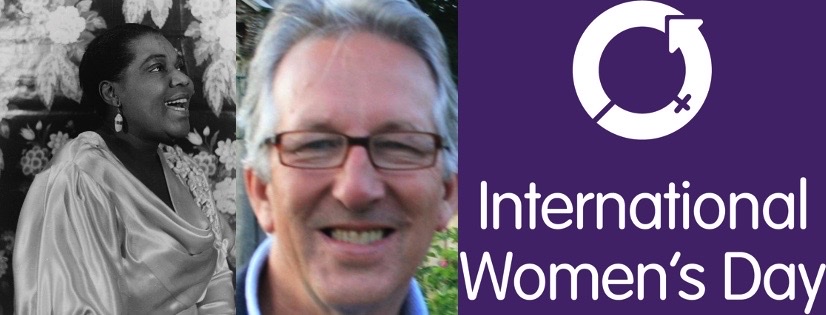
You have to be feisty to be a female jazz musician. While gender has become more complex, the complexity applies to both beings formerly known as men and beings formerly known as women. So there's a cancelling out of sub-divisions which leaves us with the original generic nomenclature needed to understand why women jazz musicians have a tougher time of it than the men, and why they need to battle on an additional front to the one jazz musicians as a whole accept as routine; and why a female jazz trumpeter might have to field a male comment about how he wished he were the trumpet engaging nightly with a ravishing embouchure.
They not only have to convince a promoter to take them on because they are jazzers; they also have to do so because they are women. It's a double bind that applies elsewhere but more tightly in jazz because jazz jostles and shoves with bourbon-swilling, beer-quaffing alpha-males (not that the women couldn't handle spirits or ale and in fair quantity).
There are exquisite examples of how the two co-exist. Miles Davis, having a relaxing intermission cigarette on the pavement outside Birdland is picked on by a bored cop because he's black and won't move on, and because the cop for no reason wants him to. Miles gets beaten up for his trouble, or lack of wanting any trouble. At a different time and asserting his superiority as a breadwinner, Miles thumps his wife, Frances Taylor Davis, after she comments approvingly on Quincy Jones's good looks, just as his father had floored his mother. Miles was high on a coke cocktail when he took a swing at Frances. The other elements in these stories – skin colour, parental example, drug dependency – can also be cancelled to leave that telling male-female fulcrum on which the ultimate balance is too often weighted in the man's favour.
It's the right juncture to clarify the position, vis-a-vis male jazz musicians and male jazz followers. The former know they are in the same boat, especially if they share the additional bonding of being black. Of course, there are plenty of examples of how the male musician's chauvinism transcends his sense of musical fraternity. But it's the male-dominated wash of jazz admirers – in the provinces at least a superannuated crowd – that one finds boring beer-soaked bias, as James Ellroy, author of White Jazz and other high-grade pulp fiction, might put it. It's possibly the women's minority status in jazz that fuels male braggadocio, the idea that they are interlopers in a male world. Look through any pictorial history of jazz and the women sometimes appear as though having been added to the population for the sake of variety – that's variety as in 'variation' or 'novelty'. Women band vocalists were singers in male bands. No male singer was ever a singer in a female band. I like to think that the petite and demure pianist Lil Hardin in the King Oliver and Louis Armstrong bands kept the boys in check. Women rode the riverboats north, too, in small almost insignificant numbers: pianist Marge Creath, among them. Lovie Austin was the distaff representative in a flotilla of Chicago-school pianists such as Freddie Shayne, Frank Melrose, and Richard M. Jones. You had to be good to hold your own in places, often the home, where men ran things, often badly. In the 1920s, women singers lifted the rafters: Sara Martin, Lizzie Miles, Mamie Smith – and above all Bessie Smith.
Listening to Bessie, one gets the impression of someone singing to be heard above a largely male throng, with its monopoly of gigs, positions of commercial power, and bandstand occupancy. Her style and appearance was diva-operatic. The story of her being refused admission to a segregated white hospital was always heroic, an indictment of pretensions to white supremacy, and an empirical reminder of what the Blues were about and why they were sung. That story, part of unexamined jazz history, has been de-constructed to the point of being refuted. After the 1937 car crash in which she was badly injured, she was advised – not much time wasted – to go to a black hospital, where, despite treatment, she died. She could have gone to an equidistant white one. Racial segregation denotes institutions that are exclusively black as well as exclusively white. In the South in the late 1930s, the reality was that the black ones were the less well-equipped. That's why she died, though she may not have recovered at the white one. Despite heavy drinking late in her career, she had been a conqueror of Boadicean stature. Like her booming contralto voice, she'd risen above the male enclave to unprecedented summits as a recording star with Columbia. Some say women musicians, because of their lesser number, have less competition than their male counterparts. But for women, the men are part of the competition, and part of the extenuating problem.